Spade
Mini Shell
| Directory:~$ /home/lmsyaran/public_html/joomla3/libraries/phpspreadsheet/vendor/markbaker/matrix/ |
| [Home] [System Details] [Kill Me] |
PHPMatrix
==========
---
PHP Class for handling Matrices
[](https://github.com/MarkBaker/PHPMatrix/actions)
[](https://packagist.org/packages/markbaker/matrix)
[](https://packagist.org/packages/markbaker/matrix)
[](https://packagist.org/packages/markbaker/matrix)
[](https://xkcd.com/184/)
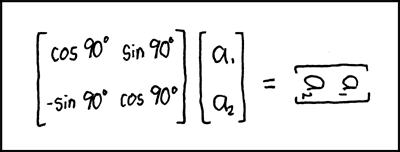
Matrix Transform
---
This library currently provides the following operations:
- addition
- direct sum
- subtraction
- multiplication
- division (using [A].[B]<sup>-1</sup>)
- division by
- division into
together with functions for
- adjoint
- antidiagonal
- cofactors
- determinant
- diagonal
- identity
- inverse
- minors
- trace
- transpose
- solve
Given Matrices A and B, calculate X for A.X = B
and classes for
- Decomposition
- LU Decomposition with partial row pivoting,
such that [P].[A] = [L].[U] and [A] =
[P]<sup>|</sup>.[L].[U]
- QR Decomposition
such that [A] = [Q].[R]
## TO DO
- power() function
- Decomposition
- Cholesky Decomposition
- EigenValue Decomposition
- EigenValues
- EigenVectors
---
# Installation
```shell
composer require markbaker/matrix:^3.0
```
# Important BC Note
If you've previously been using procedural calls to functions and
operations using this library, then from version 3.0 you should use
[MarkBaker/PHPMatrixFunctions](https://github.com/MarkBaker/PHPMatrixFunctions)
instead (available on packagist as
[markbaker/matrix-functions](https://packagist.org/packages/markbaker/matrix-functions)).
You'll need to replace `markbaker/matrix`in your `composer.json` file
with the new library, but otherwise there should be no difference in the
namespacing, or in the way that you have called the Matrix functions in the
past, so no actual code changes are required.
```shell
composer require markbaker/matrix-functions:^1.0
```
You should not reference this library (`markbaker/matrix`) in your
`composer.json`, composer wil take care of that for you.
# Usage
To create a new Matrix object, provide an array as the constructor argument
```php
$grid = [
[16, 3, 2, 13],
[ 5, 10, 11, 8],
[ 9, 6, 7, 12],
[ 4, 15, 14, 1],
];
$matrix = new Matrix\Matrix($grid);
```
The `Builder` class provides helper methods for creating specific matrices,
specifically an identity matrix of a specified size; or a matrix of a
specified dimensions, with every cell containing a set value.
```php
$matrix = Matrix\Builder::createFilledMatrix(1, 5, 3);
```
Will create a matrix of 5 rows and 3 columns, filled with a `1` in every
cell; while
```php
$matrix = Matrix\Builder::createIdentityMatrix(3);
```
will create a 3x3 identity matrix.
Matrix objects are immutable: whenever you call a method or pass a grid to
a function that returns a matrix value, a new Matrix object will be
returned, and the original will remain unchanged. This also allows you to
chain multiple methods as you would for a fluent interface (as long as they
are methods that will return a Matrix result).
## Performing Mathematical Operations
To perform mathematical operations with Matrices, you can call the
appropriate method against a matrix value, passing other values as
arguments
```php
$matrix1 = new Matrix\Matrix([
[2, 7, 6],
[9, 5, 1],
[4, 3, 8],
]);
$matrix2 = new Matrix\Matrix([
[1, 2, 3],
[4, 5, 6],
[7, 8, 9],
]);
var_dump($matrix1->multiply($matrix2)->toArray());
```
or pass all values to the appropriate static method
```php
$matrix1 = new Matrix\Matrix([
[2, 7, 6],
[9, 5, 1],
[4, 3, 8],
]);
$matrix2 = new Matrix\Matrix([
[1, 2, 3],
[4, 5, 6],
[7, 8, 9],
]);
var_dump(Matrix\Operations::multiply($matrix1, $matrix2)->toArray());
```
You can pass in the arguments as Matrix objects, or as arrays.
If you want to perform the same operation against multiple values (e.g. to
add three or more matrices), then you can pass multiple arguments to any of
the operations.
## Using functions
When calling any of the available functions for a matrix value, you can
either call the relevant method for the Matrix object
```php
$grid = [
[16, 3, 2, 13],
[ 5, 10, 11, 8],
[ 9, 6, 7, 12],
[ 4, 15, 14, 1],
];
$matrix = new Matrix\Matrix($grid);
echo $matrix->trace();
```
or you can call the static method, passing the Matrix object or array as an
argument
```php
$grid = [
[16, 3, 2, 13],
[ 5, 10, 11, 8],
[ 9, 6, 7, 12],
[ 4, 15, 14, 1],
];
$matrix = new Matrix\Matrix($grid);
echo Matrix\Functions::trace($matrix);
```
```php
$grid = [
[16, 3, 2, 13],
[ 5, 10, 11, 8],
[ 9, 6, 7, 12],
[ 4, 15, 14, 1],
];
echo Matrix\Functions::trace($grid);
```
## Decomposition
The library also provides classes for matrix decomposition. You can access
these using
```php
$grid = [
[1, 2],
[3, 4],
];
$matrix = new Matrix\Matrix($grid);
$decomposition = new Matrix\Decomposition\QR($matrix);
$Q = $decomposition->getQ();
$R = $decomposition->getR();
```
or alternatively us the `Decomposition` factory, identifying which form of
decomposition you want to use
```php
$grid = [
[1, 2],
[3, 4],
];
$matrix = new Matrix\Matrix($grid);
$decomposition =
Matrix\Decomposition\Decomposition::decomposition(Matrix\Decomposition\Decomposition::QR,
$matrix);
$Q = $decomposition->getQ();
$R = $decomposition->getR();
```